
Podcast: Play in new window | Download

Dan:
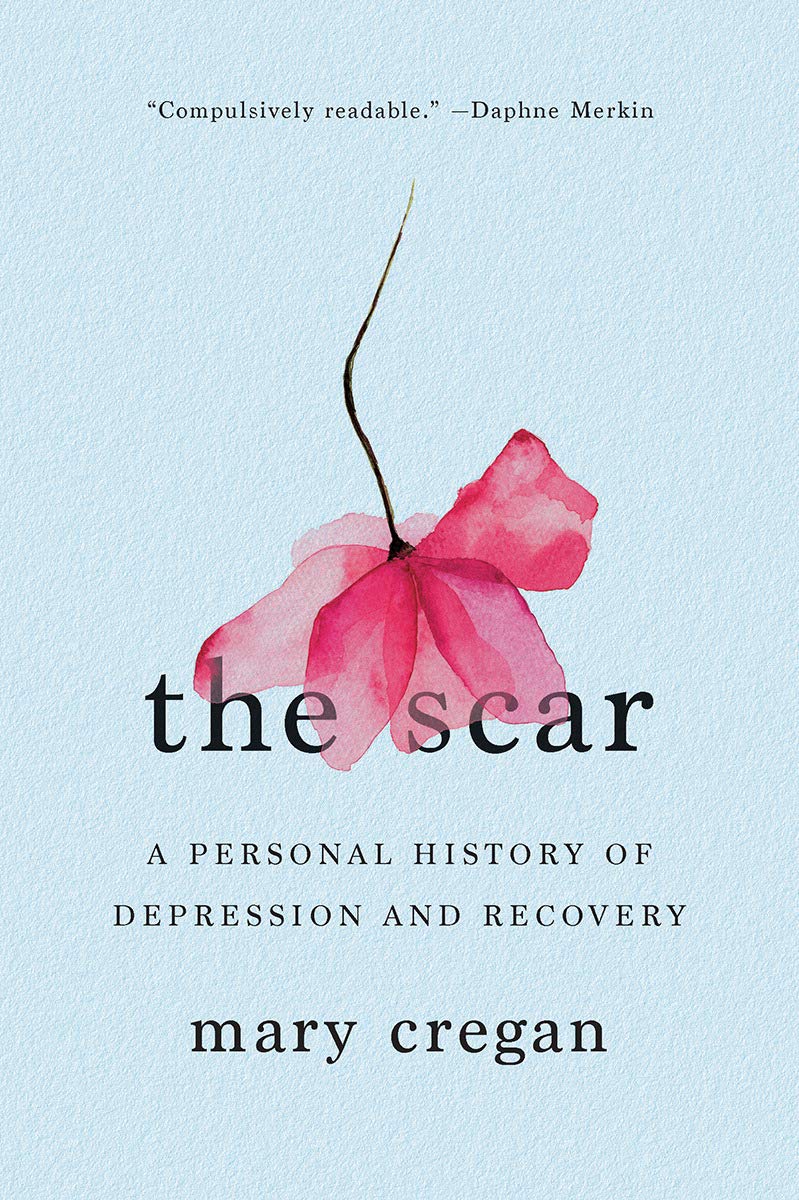
I’m Dan Lukasik. Today’s guest is Mary Cregan, author of the book The Scar: A Personal History of Depression and Recovery. Mary received her PhD from Columbia University and is a lecturer in English literature at Barnard College in New York City, where she lives with her husband and son. Welcome to the show, Mary.
Mary:
Thank you, Dan.
Dan: Mary, where does the title of the book come from?
Mary:
The title is the origin of the story, really. I have a scar from a suicide attempt I made in the very intense depressive episode that followed the death of my first child. That was when I was first diagnosed with major depression. The story that I tell in the book goes back to that scar which, of course, is with me always and is a kind of memory on my body of that experience. Because of the scar I try to return to that time to tell the story of my depression and the larger history of depression.
Dan:
Can you lead us up to the time of your first suicide attempt? In your book, you mention the passing of your daughter. Take us back to that time and what happened.
Mary:
I was 27 when I was pregnant for the first time and was married to my college boyfriend, who was a few years older than I was. I was working in publishing in New York City when I left college and he was working in New York as well. We had just moved up to Westchester County to a house with some bedrooms and an outdoor space, thinking that we could have a little more room for having a child.
The death of my daughter was completely surprising. I had a very easy full term pregnancy. I went into labor on my due date—it seemed as though everything was going perfectly. After she was born it was clear that she was not very responsive. Her Apgar score was low and over the next say, day and a half they did a variety of tests and ended up taking her up to Mount Sinai for an echocardiogram, which showed that she had a terrible heart defect, a condition called hypoplastic left heart, which means that the heart is not developed on one side.
It was the end of 1983, when this was basically a death sentence. She didn’t live for more than a few hours after we received this diagnosis. We were both really shocked. But what happened next was, we went home to this house that we had just moved into with no baby and I became very depressed. But I didn’t know what depression was, nor did anyone else around me … I did not come from a therapeutic environment.
That’s the wrong way of putting it. I didn’t come from people who had had anything to do with psychiatrists or therapists. And we just didn’t know what was going on. We just thought this was a situation of grief.
Dan:
Can you tell us at the time, you said you came home and became depressed, what were the symptoms or what do you recall about that time that led you to believe that you were depressed? Can you describe it to us?
Mary:
I was trying to figure out how I could get a new job because I felt very unhappy and I needed something to focus on, to kind of lighten my energies. And I was trying to find how I could get a new job while also being on a short maternity leave from the job I was still holding. And I just kept not being able to settle on anything that felt meaningful. I suppose that what I was suffering from was a state of profound meaninglessness and not knowing how to hold on to the future.
The future was completely unknown. I was trying to grasp something, but I couldn’t. And a couple of months after the death of my daughter I woke up one morning and said to my husband that it would be better if I were dead. Then it was suddenly clear that we had a serious problem. He consulted his father who put us in touch with a psychiatrist and I started seeing the psychiatrist fairly quickly.
Dan:
That was before the hospitalization?
Mary:
That was a couple of weeks before. I would say two or three weeks.
Dan:
And how were they trying to treat you at that time?
Mary:
It was therapy. I’d gone back to work and I would come home on the train and then go and see the psychiatrist in the evening. It was every evening, Monday through Friday. He put me on a tricyclic antidepressant, gradually increasing the dose. But I think it was too late. I was very, very suicidal and I was going to work and trying to focus but the medication wasn’t turning things around quickly enough. Then one day I came home from work and cut my wrists and ended up in the hospital with that suicide attempt. What I’m trying to talk about here, as grim as it sounds, is a complete loss of connection to the world.
Dan:
How long were you in the hospital for, by the way, Mary?
Mary:
I was in the hospital for three months. Let me go back. Maybe I can read a little bit, where I describe what it felt like in those days before I entered the hospital. I had tried a variety of things. I tried volunteering at the pediatric ward of a local hospital, I tried going to talk to a priest at the Catholic church in my town, nobody was there. It’s really a story of someone wandering around trying to find something to feel hopeful about or feel a connection to. This is from a description of that period:
“None of my half-hearted attempts to return to life in the world had made me feel any better. Anxiety was becoming an overwhelming physical sensation. Something rising from my gut, grappling at my ribcage, making it hard to breathe. Sometimes it was an involuntary clenching of my muscles, tightening and releasing, over and over. I couldn’t sleep for more than a few hours at a time. I woke in the dark at 3:00 or 4:00 in the morning and sat up with my heart pounding, my body revved up and panicked, flooded with adrenaline.
Then I’d realize that nothing was going to happen. This was just the too early beginning of yet another day. I would lie down again and try to go to sleep, my mind churning with anguish, spinning its wheels through the various unlikely fixes for the unmoored condition I was in: get a new job, apply to graduate school, move back to the city, move to the country. Suicide began to press itself into this list of potential solutions. The powerful feeling of loss had turned into something else, a heavy internal collapse, a constant thrumming of dread, a suffocating inwardness, a conviction that I was permanently cut off from the world and other people, marooned in the hell of my own consciousness. Living in time had become a torment. Each day felt endless with no sense of forward motion, no anticipation of the future, no belief that I would ever feel better. Time was unbearable. Time needed to stop. One morning I announced it would be better if I were dead.”
Dan:
That says so much. I think it helps us understand the hopelessness or the perceived hopelessness of the situation. And then in the hospital, it was decided that you would undergo ECT treatments. Is that correct?
Mary:
Yes.
Dan:
What is ECT and how was it performed on you?
Mary:
When I was in the hospital they decided that after I made this very minor suicide attempt at home, they would continue with the medication trial that I was on. The assumption was that it just needed more time and now that I would be in a safe environment they would continue with that. But on my second day in the hospital, I made a suicide attempt that was very, very serious, and that was the end of the medication trial. They said, “We now have to do ECT and if you don’t agree we will get a judge’s order.”
My husband (now my ex-husband) had once seen the movie One Flew Over the Cuckoo’s Nest and was terrified at the whole notion. Just the mention of ECT was terrifying. Of course, what I had done was also terrifying. So, I said, “Of course, let’s try this.” I didn’t really have any hope of any other … I didn’t have any other ideas. I didn’t really believe in anything at that point, in anything working. I was in a state of such profound hopelessness. So, it began, and what can I say about it? It was scary, but ultimately it worked.
Mary:
I signed a paper giving permission, which set out that this might not work and there are various side-effects. But it was quite straightforward. You lie down on a table and you go under anesthesia. They put the electrodes on your forehead. They give a quick-acting anesthesia and give the electrical charge, which creates a seizure. This seizure is an attempt to reset your brain—that’s one way of thinking about it.
Mary:
I have a chapter on ECT in the book in which I talk about the early history of various convulsive therapies for mental illnesses, including schizophrenia. But ECT was found to work really well for melancholic depression, which was my diagnosis.
Dan:
Throughout the book you make a distinction melancholic depression and depression. What do you mean by melancholic depression?
Mary:
The word “melancholia” is an ancient word that comes from the Greek, a term that was given to something was noticed by Greek physicians before the birth of Christ, during the Hippocratic era. This was when the humors were still considered to be part of what doctors would use to diagnose people. So, the humor of melancholia was caused by black bile in the body. And it was described as a prolonged state of fear, anxiety, hopelessness, and the inability to sleep.
So this condition has been recognized in medicine for a very long time. But melancholia is now considered a type or “specifier” of major depression, a term that only came into being in 1980 with the third edition of the Diagnostic and Statistical Manual of Psychiatry.
If you look up the word melancholia in the New York Times archive, you will almost always find it attached to the story of a suicide. When melancholia made the news, it made the news because someone with melancholia had committed suicide. I was looking it up in the New York Times and most of those stories came from the 19th century and the early 20th century. Later, psychiatrists started using the term “depression” more generally, and the condition received the new label “major depression” in 1980.
Mary:
So nowadays in the Diagnostic and Statistical Manual, melancholia is a specific form of depression. So, my official diagnosis was major depression with melancholia.
And there are other forms of major depression. There’s a more anxious type, etc., but melancholia … I could read, I suppose, something else here.
Dan:
That’d be great, Mary.
Mary:
There also used to be two terms in psychiatry, endogenous and reactive:
“Endogenous depression means within the organism, which suggests that what was wrong with me was driven by disorder in my body and was more than a psychological and emotional reaction to my bereavement. This kind of depressive illness used to be called melancholia.”
So, my diagnosis in the hospital was major depressive episode with melancholia–a kind of syndrome with tremendously raised levels of stress hormones, with inability to sleep, with something lodged in your brain that refuses to let any light in.
I’ll read a passage about it here. “Biological psychiatrists understand melancholia as a severe mood disorder associated with dysfunctions along the body’s hypothalamic pituitary adrenal axis, or the HPA axis. People with melancholia have very high levels of the stress hormone, cortisol, a disordered sleep, wake cycle, slowed speech and movement and diurnal swings in mood, which is darkest in the morning and improves slightly as the day goes on.
They express an overwhelming sense of hopelessness, failure and guilt. Sometimes they are psychotic, very often they are acutely suicidal. A recent textbook defines the illness as a recurrent, debilitating, pervasive brain disorder that alters mood, motor functions, thinking, cognition, perception and many basic physiological processes. Postpartum and bipolar depressions can also take this form. The gloom is unremitting and efforts to cheer up the patient have no effect.
Sufferers are trapped inside a totalizing negativity and it is hard to reach them with rational thinking. When they are very ill and delusional psychotherapy is of no use at all. It might help them to know that their illness is unmistakably a real illness, not a manifestation of weakness, moral failure or an inferior character if they could only hear this truth. But usually they can’t.”
Dan:
Mary, at some point you were discharged from the hospital after three or four months. Can you describe what you did next?
Mary:
I came out of the hospital and returned to work at the time while I tried to figure out how to, once again, find a way to move forward in my life, which had now begun to feel really broken. With that stay in the hospital, the diagnosis, my new life as a psychiatric patient, it now felt that I was damaged. I was afraid of it coming again, the kind of bottomlessness that had opened up under me.
And I had returned to my marriage, which was challenged because I had realized in the hospital that it was something that I also didn’t have much faith in, in terms of feeling good about the future. I was in therapy. I went back to work and I eventually applied to graduate school, because I thought that reading literature was a way of attaching myself to something very meaningful. It was something that I had studied in college and not gone forward with. I thought I would try and make a career as a teacher and scholar. I was in therapy, which was a kind of grounding work in trying to hold my life together. I had a really good psychiatrist.
Dan:
And in the book, you write about your Catholic upbringing in a big Irish family and this sense of not wanting to be self-disclosing as it relates to what you went through with your depression and your suicide. Can you tell us a little bit more about that theme that runs through the book about shame and stigma and how you experienced it?
Mary:
My four grandparents were from Irish farm families and all four of my grandparents immigrated in the 1920s. My parents were born in Philadelphia in 1930 and I grew up in the same neighborhood as my grandparents.
I went to the same Catholic school that my mother had gone to and my father’s parents lived quite nearby. So, we grew up in a very Irish Catholic environment, almost as if nothing had changed. That is, the adherence to going to mass every Sunday and going to Catholic school and going to confession and a kind of internalized sense of surveillance, even. You had to constantly be careful that you were being good, this was partly the Catholicism and also partly the fact that I was one of six children and the eldest girl meant that I did not want to cause any trouble. Certainly, I was encouraged not to cause any trouble for my parents. I think that there was a feeling of having to be accountable all the time. And this was possibly also just for reasons of temperament—maybe it’s my character that I had an acute sense of responsibility. But I have read, actually—it was in one of Peter Kramer’s books on depression—that in Germany, one of the character types associated with depression is the person who feels extremely perfectionistic, very responsible, very, what’s the word? I suppose it’s a Type A personality in a way and that feeling that you have to do everything right.
Dan:
In your book, you write about the character traits of those with melancholic depression. One of those traits being empathy. You wrote that sufferers of this type of depression are more apt to feel empathy towards other people. There is also a tendency toward perfectionism. You write that you saw such character traits in yourself as a child.
Mary:
I think I did. In retrospect, maybe it was clear that I was going to be a person who would become a literature teacher. If people are not talking about their feelings around you, then you have to find a different way of being able to process emotion. And reading books and fiction and literature is a place where you can find a way of allowing that in your life.
Dan:
Were there any books that spoke to you particularly in that regard, Mary?
Mary:
When I was a child, we went to the library every week and brought home lots of books. So, I read a lot and it was a way of having some solitude in a very large and busy household. By the time I was in high school, I started reading poetry and I would write down poems and that was also when there was lots of great music, folk music, and I would write down the words of songs. And by that time, it’s clear to me now looking back that I was having smallish depressive episodes by the time I was in high school.
So, I see that kind of behavior—writing down poems or reading poems—as a way of trying to tend to my emotional life. But in terms of my family, because there had been a lot of hardship, and because of their Irish background, there wasn’t really any attention to, what would you call now, emotional intelligence. Also, there was a kind of stoicism that maybe you also recognize from your background, Dan, where people wouldn’t talk about how they were feeling or their moods or whatever. It seemed self-indulgent to call attention to yourself – it was just not done.
Dan:
When you were hospitalized and attempted suicide, how did your parents and siblings react?
Mary:
They were completely shocked and stunned. I was not the person that they would ever have expected this to happen to. I talk in the book about having a sort of double consciousness where, as I grew older and certainly by the time I was in high school and in college, I knew that I felt troubled within myself. And now I recognize that I was troubled because I was having some depression, but I was outwardly a very good student and I had friends and I seemed like a successful person.
So, there would have been no expectation that something so catastrophic would happen, that I of all people would become suicidal. It was completely shocking. And of course, what happened to my child would be shocking to anyone in any family. My family was traumatized by it, perhaps. She was the first grandchild. Everything had seemed perfect in my life. But my being in therapy was another first for my family, and that was weird for them. The fact that I now had this job of attending to my psychic life and discussing my thoughts and feelings with the doctor was alien to them.
Dan:
After your release from the hospital and going forward, would discuss with any of your family members that insights you gained from being in the hospital, or did you keep them private?
Mary:
I talked to my parents about things because in the years that followed, I was separated from my husband and they were really not happy about that because they were Catholic and you are not supposed to get divorced. I remember talking with them about the marriage and various other things. In fact, I think one result was that my parents now found that they had someone they could talk to for the first time.
I was opening up to them and they could open up to me in a way, so it became a way of having honest conversations in my family. I did that more with my parents, with my mother, especially, than with my siblings who were living further away.
Dan:
You wrote that at some point, it may have been during your hospitalization, you discovered that other people in your family had struggled with depression.
Mary:
My father told my psychiatrist in the family meeting upon my admission to the hospital that he was taking an antidepressant himself. I found this out when I wrote away for my hospital record when I decided to write this book. It was surprising that after 30 years they would have this record and make it available to me.
That was one of the things that allowed me to go back to that time and see it so clearly, because it was all written down in the hospital record. I got an extraordinarily clear sense of what my treatment was and what I was like when I was so ill, because I would have no memory of that otherwise.
Dan:
Sort of like your older self, looking back on your younger self?
Mary:
Yes, it’s amazing. I had some journals and I had a notebook that I kept in the hospital at the suggestion of my psychiatrist there when I was undergoing ECT for six weeks. I had a lot of ECT treatments because it was just not working, until suddenly it worked. But he suggested I keep a journal because ECT causes amnesia after a while—you have a loss of short-term memory. My husband would come and visit me on the visiting nights, which were like only two nights a week, and I wouldn’t be able to tell him about my days because I couldn’t remember what happened. I started writing things down in the hospital because of course there’s lots of time when there’s not much to do. And that became a great resource for returning to this period and being able to look at it and see myself in that time. And yes, it’s exactly like an older self looking at a younger self.
But also, a self that had a lot more compassion. I had so much more compassion for myself looking back than I had for myself at the time, if you know what I mean.
Dan:
You’ve said that it took you a long time to write the book, but the impulse to write it persisted. Why did you finally decide to write it?
Mary:
I was supposed to be writing, as an academic. But as an adjunct I was not on a tenure track, so I did not have to write a tenure book. Everyone around me has been writing books. My friends are writers and my husband is a professor and writer who’s just published his seventh book. All that time I was really blocked but I always knew that this was something that I wanted to write about.
But I couldn’t bring myself to expose myself in the way that would be necessary to tell the story that I tell in this book. And that’s the real reason that I never got around to it earlier.
Dan:
That makes sense. We’re all glad you got around to writing it. It’s a fantastic book.
Mary:
I knew that this was a book that I needed to write. I finally decided I would go ahead and write it for myself, even if it would never be published. Because I wanted to describe and process this experience, which had always felt so troubling to me. I felt that I had never regained something that was lost when I had this crisis in my life. I guess I was suffering from a lingering sense of failure, because in my life I’m surrounded by a lot of very successful people and I was troubled by that.
I wanted to see whether I could write this book because I knew that I had something to say about this experience. That was why it never really left me. Finally, I just realized, go ahead and do it and then you can decide whether to try and publish it or not.
Dan:
And then you did decide to get it published?
Mary:
I did. Once there was so much work involved, I thought, “I might as well try and publish it.” And the longer I worked on it, the more I got used to … or I was, I guess, kind of inured to the feeling of exposure. And I’m nearing the end of my teaching career and I thought at this point, “Do I really care who knows this about me? It’s not so scandalous. It’s not so criminal.” There’s a lot of guilt and shame associated with suicide and with being suicidal.
But as I said, when you look back and you see the suffering involved and you see the illness so clearly, which is what I was able to do when I went looked at the record and looked at my notes and learned more about the illness. I thought, there’s nothing shameful here.
Dan:
That comes out loud and clear, but it takes a long time to come to that very visceral sense, that truth that there’s nothing to be ashamed of here, but it takes so much longer to come to that by one’s self. You also had a second child, a son, and there’s one point in the book, a powerful moment, where you and your second husband visit your daughter’s grave and you bring your new son with you. Why did you do that and what did it mean to you?
Mary:
There’s a chapter in the book about mourning and melancholia. I knew when I wrote the book that I wanted to address Freud’s famous essay called “Mourning and Melancholia,” because after I got out of the hospital I still needed to mourn for my daughter. That had been interrupted by my descent into a very severe and, at times, psychotic depression. Part of the work of recovering was coming to terms with that loss.
After my first husband and I got divorced, I needed to find a place to lay my daughter’s ashes to rest. We had been in college in Vermont and there was an old cemetery there where I decided to buy a small grave and headstone, and I buried her ashes there. That was very meaningful. I put a brief quote on her grave from T. S. Eliot’s poem, “Marina.” That was before I met my second husband.
This was the cemetery that I returned to later when my son Luke was a baby and my husband Jim and I were spending time in Vermont. I had walked into the cemetery and over to the stone and I noticed that Jim had come up and was standing next to me holding Luke.
There was a profound sense for me of the past and the present being together in the same moment. It was beautiful that my husband wanted our baby to see the grave of his sister. It was a generous thing that he respected the significance of it. That’s a moment towards the end of the book.
Dan:
You write about a profound sense of gratefulness that you didn’t succeed in taking your life, otherwise, your son Luke would never have been born. Can you talk about that?
Mary:
I think anyone who has survived a suicide attempt feels an incredibly profound good fortune to have been unsuccessful. I’ve been grateful ever since I recovered from that very severe depression. It would have been so devastating for my family.
Dan:
They probably would never have recovered.
Mary:
One of the things I try to draw attention to in this book is that the danger of severe depressive illness is precisely suicide and the damage that leaves behind. I was fortunate not to wreak that kind of grief on my survivors, in addition, of course, to getting to have my own life, you know?
It’s a very, very serious thing, this illness. And I’m really happy that you’re bringing attention to it, and that you, yourself, have survived the suffering that you’ve gone through.
Dan:
I think one of the things that struck me about the book was your search not only for a sense of meaning and trying to understand your own personal journey, but then the more universal experience of depression, for millions and millions of people, people who suffer and struggle. And I thought you gave a very articulate voice to that struggle. Mary, where are you today? Do you continue to struggle with depression?
Mary:
That’s a good question, because as we speak we’re eight or nine weeks into the lockdown in the coronavirus pandemic. And I keep expecting depression to set in, because that will be happening to people as we feel trapped and don’t know what the future is holding. And so many people have lost their jobs—those are the people that I really worry about. But so far, I haven’t fallen into a serious depression and I hope that won’t happen.
Every day now I go out for a very long walk. I’ve been going to Central Park and the spring has not cared about the coronavirus, because the spring has been very beautiful.
[Post-interview addendum: I meant to say here too that near daily exercise is a commitment I’ve made to my health. It restores energy that depression depletes. It provides a chance to socialize when I go to the gym and see friends there. It also relieves tension and stress. I also take an antidepressant faithfully, despite sometimes wondering how I would do without it. Given my history it seems wiser to keep up with that.]
Dan:
You actually wrote an article about spring last year in the New York Times which I read. Why did you write that article?
Mary:
Well, in my book I recount that the time when I became suicidal was from December to March. That was the period from the death of my daughter to my entry into the hospital. As I became more and more suicidal, the spring was coming and I thought, “If I make it to spring, I’ll be okay. It’ll all be okay.” And I did not feel okay, and I attempted suicide on the second day of spring.
So, I ended up thinking a lot about that when I read later on that spring is a time when suicide is at its highest. It’s not significantly higher, but it’s been statistically notable. This may be because of the feeling depressed people have of being left behind when the energies at that time of the year shift. The sun comes out and people go outside and those who are left behind feeling terrible, perhaps then feel even worse.
Dan:
I remember being with my family 20 years ago when I was first diagnosed with major depression and we were in the park in Disney World and I was sitting on a bench and watching my wife and child. My daughter was small at the time and seeing all the happy people around me and feeling utter desolation, no happiness, no joy. I felt guilty about it. I felt, what kind of person am I not to share in the happiness and joy of my own family even to take part in life?
But that was one aspect of my depression, not feeling engaged in life, not feeling any joy in life. And perhaps, for many people, including myself, that could be one of the worst aspects of depression. We all live for that. We all live to not just survive life, but to enjoy life. And that’s something that depression, especially when it’s untreated, can take from us.
And I got to say, Mary, I just got so much out of your book and I’m going to recommend it to everybody and thanks for taking the time today to talk.
Mary:
I really appreciate it Dan, and I hope we can talk again sometime.
Dan:
Yes, me too.
The National Suicide Prevention Lifeline provides 24/7, free and confidential support for people in distress, and prevention and crisis resources for you or your loved ones. Call 1-800-273-8255. In case of an emergency, always call 911.
Visit the Depression and Bipolar Support Alliance website for more information and resources if you or a loved one are dealing with depression.
Don’t forget to check out Mary’s website.